


Close
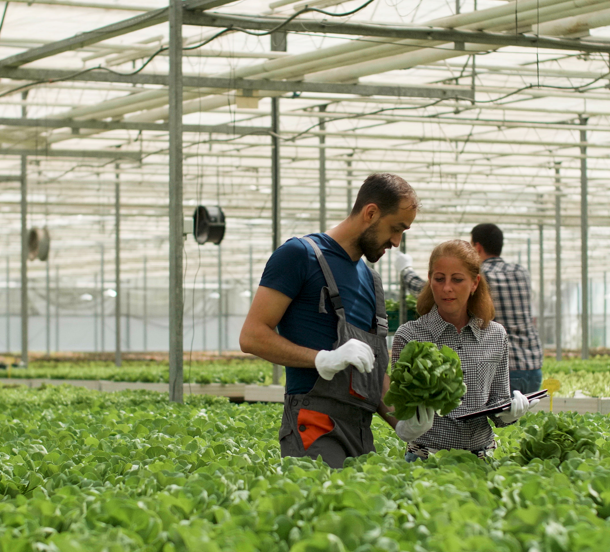
Walk through an apple orchard or wheat field with an experienced farmer and they’ll point out details invisible to untrained eyes. A slight discoloration on leaves. The pattern of pest damage. Areas where growth looks off. This observational skill, built over years of experience, has always been agriculture’s foundation.
Now imagine giving that observational capability to a machine that can scan every plant in a field, process what it sees in real-time, and make split-second decisions about treatment. That’s what computer vision brings to precision agriculture.
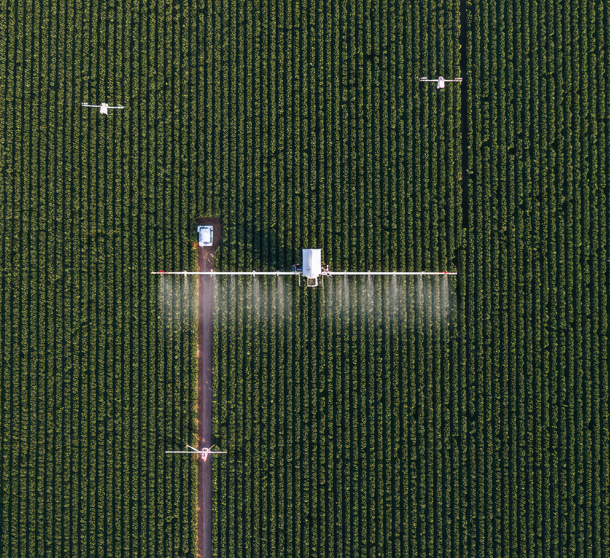
Computer vision works by training AI models on thousands of images of crops, pests, and diseases. For Smart Droplets, that means cameras mounted on spraying equipment capturing continuous streams of data as tractors move through fields. The system learns to recognize specific problems: apple scab on fruit trees, sclerotinia in wheat, and common weeds like blue and tansy mustard.
But recognition alone isn’t enough. The system needs to assess severity, estimate how much damage has occurred, and determine the outbreak’s extent. Is this a few scattered pest instances or a widespread problem? Is the disease at an early stage where minimal intervention works, or does it require more aggressive treatment?
This is where advanced AI architectures come into play. Models need to process images fast enough for real-time decision-making, over 20 frames per second, while maintaining accuracy above 85%. They’re optimized and compressed to run on edge computing devices mounted directly on the tractor, eliminating delays that come from sending data to the cloud and waiting for responses.
Computer vision in Smart Droplets does more than spot problems. It characterizes the crop canopy using 3D imaging, measuring plant volume, canopy density, and presence. This matters because spray application needs to be adjusted based on how much plant material is actually there.
Dense foliage requires different treatment than sparse growth. The system can modulate not just which chemicals to apply and in what quantity, but also adjust the air and liquid flow rates for optimal coverage and penetration. This real-time adaptation means more efficient use of inputs and better treatment outcomes.
The same canopy characterization helps with fertilization decisions. Nitrogen application, whether for wheat or apple foliar feeding, can be precisely calibrated to actual plant needs rather than applied uniformly.
Here’s where computer vision becomes particularly powerful: it creates a continuous feedback loop with the Digital Twin system. Before spraying begins, the Digital Twin makes predictions about where diseases or pests are likely to appear based on weather data, historical patterns, and agronomic models.
During spraying, cameras validate those predictions in real-time. Did the Digital Twin correctly predict where apple scab would develop? Are pest instances appearing in unexpected locations? This immediate feedback allows the system to adjust recommendations on the fly and improve future predictions.
The data collected during each spraying operation becomes training material for the next iteration. The AI models get smarter with every field pass, better at recognizing problems under different lighting conditions, at different growth stages, across varying weather conditions.
The technology sounds sophisticated, and it is, but its value lies in practical outcomes. Farmers don’t need to understand convolutional neural networks or edge computing architecture. They need to know that the system can identify problems accurately and recommend appropriate responses.
That’s why computer vision in Smart Droplets is designed for transparency. The system doesn’t just say “apply treatment here.” It shows what it’s seeing, explains why it’s making specific recommendations, and flags situations where human judgment is needed. When the AI encounters something unusual or outside its training parameters, it knows to ask for help rather than proceeding blindly.
Computer vision in agriculture is still evolving. Current systems work well for targeted problems, the specific pests and diseases they’re trained on. Expanding that capability to recognize a broader range of issues, to work across different crop types, to maintain accuracy under edge cases, requires continued development and validation.
But the fundamental shift is already happening. Crop monitoring is moving from periodic human inspection to continuous automated observation. From treating based on calendar schedules to intervening based on actual need. From uniform application to precision targeting.
The farmer’s eye isn’t being replaced. It’s being augmented with capabilities that would be impossible through human observation alone: the ability to assess every plant, to quantify severity objectively, to integrate visual data with predictive models, to make consistent decisions at tractor speeds.
That combination of human expertise and machine vision represents the practical future of precision agriculture. Not replacing the farmer, but giving them tools that extend their capabilities in ways that make both environmental and economic sense.
Smart Droplets uses computer vision and AI to enable real-time crop monitoring during spraying operations, targeting specific pests and diseases in apple orchards and wheat fields. Learn more at smartdroplets.eu