

Close
A soil moisture sensor registers a reading. A camera captures an image of leaves. A weather station records temperature and humidity. In isolation, these are just numbers. But within a precision agriculture system, each measurement begins a journey that ultimately influences decisions about crop treatment.
Understanding this journey helps explain how data-driven farming actually works in practice. It’s not magic, and it’s not simple automation. It’s a carefully orchestrated process of collecting, processing, analyzing, and acting on information.
Smart Droplets pulls data from multiple sources simultaneously. Field sensors measure soil conditions, moisture levels, and nutrient status. Weather stations track temperature, rainfall, wind, and humidity, both current conditions and forecasts. Cameras on the tractor capture real-time images during spraying operations. GPS provides precise location data. Historical records from previous seasons add context.
Legacy datasets, information farmers already have about their fields, get integrated alongside new measurements. Farm management software they’re already using feeds into the system rather than being replaced by it. The goal is augmentation, not wholesale replacement.
Each data stream has its own format, timing, and technical specifications. A weather API returns information differently from a soil sensor. Images from cameras require different handling than numerical readings. Getting all these disparate sources to work together requires careful attention to interoperability.
The raw measurements flow into a data management platform designed to handle heterogeneous streams. Here’s where syntactic and semantic interoperability come into play, making sure different data types can be understood and used together.
The platform organizes information into data warehouses structured for efficient access. Some data feeds are training for AI models. Some updates the Digital Twin’s understanding of current field conditions. Some provide real-time input to navigation and spraying systems. The same measurement might serve multiple purposes, so the system needs to route it appropriately.
Data processing happens both in the cloud and at the edge. Historical analysis and AI model training occur on powerful cloud servers. Real-time decisions during spraying operations use edge computing on the tractor itself. This split architecture balances computational power with response speed.
Individual measurements become more valuable when combined with others. The Digital Twin framework takes incoming data and creates a dynamic virtual representation of the field. It’s not just a snapshot; it’s a model that simulates crop growth, predicts disease development, and estimates future conditions.
Process-based agronomic models provide the foundation. These encode expert knowledge about how crops grow, how diseases spread, and how weather affects plant development. AI models trained on historical data add predictive capability that can adapt to specific conditions. The combination allows the system to make recommendations that are both scientifically grounded and empirically validated.
When a soil moisture reading comes in lower than optimal, the Digital Twin doesn’t just register that fact. It considers upcoming weather forecasts, crop growth stage, historical patterns, and current pest pressure to determine whether irrigation is needed and when. It evaluates different scenarios, such as what happens if we water now versus tomorrow? What if the forecast changes?
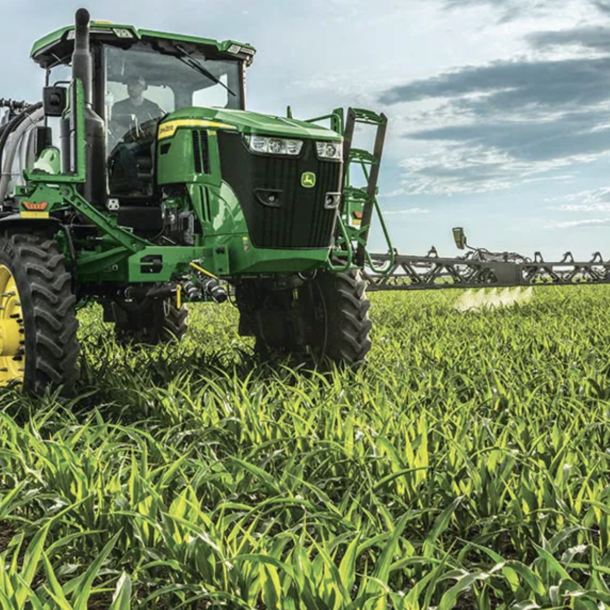
As the autonomous tractor moves through the field, data flows continuously. Cameras capture images at over 20 frames per second. Location updates constantly. The spray system monitors tank levels and injection rates.
AI models running on edge devices process this stream in real time. They detect pests and assess severity. They characterize canopy density and adjust spray parameters. They validate the Digital Twin’s predictions against actual observations and flag discrepancies.
But the system is designed to recognize its limitations. When encountering something unusual, conditions outside its training parameters, equipment anomalies, or unexpected field obstacles, it flags for human review rather than proceeding blindly. The farmer remains in the loop for decisions that require judgment beyond what the AI can provide.
Each spraying operation generates new data that feeds back into the system. Which treatments were applied where? How did the crop respond? Did pest pressure develop as predicted or differently? Were there areas that needed retreatment?
This feedback improves future predictions. The Digital Twin becomes more accurate at forecasting disease development in these specific fields under these specific conditions. AI models refine their pest detection capabilities with real-world examples. The system learns from experience.
Data from Smart Droplets fields also contributes to broader agricultural knowledge. Anonymized and aggregated information can help improve models that benefit other farms. Individual measurements, carefully collected and processed, become part of a larger ecosystem of agricultural intelligence.
Throughout this journey, human expertise remains central. Farmers and agronomists interpret results, validate recommendations, and make final decisions. They provide ground truth when the AI misidentifies something. They adjust strategies based on factors the system doesn’t capture, economic considerations, market conditions, and long-term farm plans.
The data journey isn’t about removing human decision-making. It’s about providing better information at the right time to support those decisions. A well-designed system makes its reasoning transparent, shows confidence levels in its recommendations, and explicitly indicates where human judgment is needed.
Individual measurements are valuable, but the real power comes from handling thousands of measurements across multiple data streams in real time. This requires robust infrastructure, reliable sensors, stable communications, efficient data processing, and systems that continue operating even when connectivity is imperfect.
It also requires standards and interoperability. Agricultural data systems need to work with equipment from different manufacturers, integrate with various farm management software, and communicate using common protocols. Smart Droplets follows agricultural standards like ISOBUS where applicable and contributes to developing standards where they don’t yet exist.
That single soil moisture reading, combined with hundreds of other measurements, processed through multiple systems, validated against predictions and historical patterns, ultimately influences whether a specific area of the field receives treatment, what treatment is applied, and in what quantity.
One measurement becomes part of a decision that reduces chemical use, improves targeting, protects crop health, and supports both economic and environmental sustainability. The journey from sensor to action, when done well, represents precision agriculture at its practical best.
Smart Droplets integrates multiple data streams, from sensors, cameras, weather stations, and historical records, to enable precision spraying decisions in real time. Learn more at smartdroplets.eu