

Close
By reframe.food
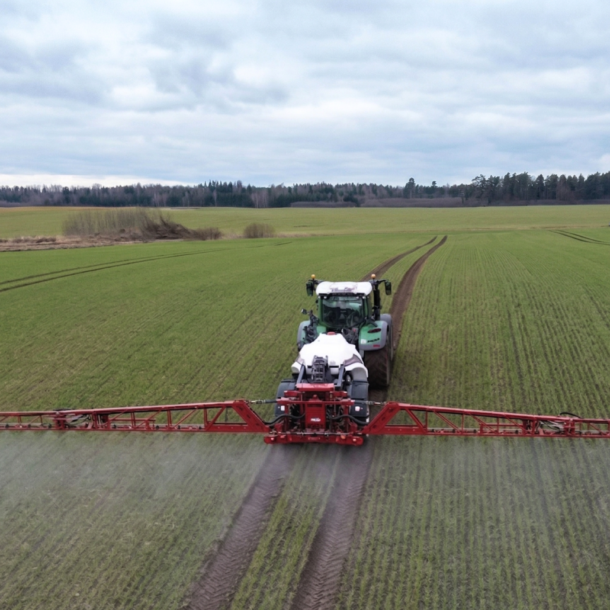
Precision spraying is usually debated as a sustainability story or a cost story. Both are accurate and both leave people out. If the question is “who actually gains when a field is sprayed more carefully?”, the answer is longer than either frame usually admits.
Start with the farmer. The obvious gain is inputs: less chemical bought, less waste, less of the input-cost risk that makes a bad season a worse one. The less obvious gain is time. A variable-rate pass that skips clean strips is shorter than a blanket pass, and fewer passes over a season free up weather windows that are already narrowing. For smaller operations, the gain is also in record-keeping: the same software that drives the sprayer usually writes the treatment log required by auditors and buyers.
Move to the neighbour. Precision spraying reduces off-target drift. That matters for the farm two fields over whose organic certification depends on no residues arriving uninvited. It matters for the household whose garden sits at the edge of a cereal block. Drift reduction is a boundary-crossing benefit that the field where the spraying happens does not directly see.
Then the consumer. Lower residues on finished produce are a direct result of lower applied rates, and the European residue monitoring system that underpins food safety reporting picks up even small shifts. The benefit is slow and statistical rather than visible on any single tomato, but it compounds at the scale of the market.
Water bodies are harder to personify but cleaner to quantify. Less drift and less over-application mean fewer pesticides and fewer nitrates in ditches, streams, and groundwater. Water utilities downstream of agricultural catchments spend real money removing what did not have to enter in the first place. Their customers are the final beneficiary of that removal, and they pay less when there is less to remove.
Pollinators and non-target species are often discussed as environmental beneficiaries, but they are also economic ones. The insects that return the following spring are the same ones that pollinate the crop next door and the wildflower margin that supports the rest of the farmed landscape. Drift reduction is one of the few levers that reduces exposure without reducing efficacy on the target pest.
Regulators and insurers sit slightly outside the field but benefit all the same. Lower residue and runoff pressure makes enforcement cheaper and less contentious. Better treatment records make claims easier to resolve when weather or disease disrupts a season.
Projects like Smart Droplets are part of the wider European research effort to make these benefits more reliable, not more dramatic. The technology is rarely the hard part. The hard part is making the benefits distributable, so that small farms can access the same precision tools as large ones.
Who loses? Honestly, not many. The clearest loser is the assumption that “more is safer”, an assumption that has been quietly wrong for a long time. Behind it sits the habit of blanket application, and it is the habit that precision spraying is designed to replace.
Every field is also a neighbourhood. The beneficiaries of precision are scattered across it, and that dispersion is part of why the case is sometimes harder to make than it should be.