

Close
By reframe.food
Farms have been technological for a long time. The plough was a technology. So was the tractor. So was the hybrid seed, the nitrogen synthesis process, and the centre-pivot irrigator. Every generation finds a way to accuse the previous one of resisting change and then quietly adopts the change the generation after brings in.
“Digital” is the current descriptor. The question worth asking is what it actually means, because it does not mean the same thing as its predecessors.
Mechanisation replaced human and animal muscle with engines. A horse pulled a plough; a tractor pulled a heavier plough faster. The task was essentially the same; the scale changed. Automation replaced human control of the mechanical action. A driver used to steer every row; an auto-steering system steers the row for them. The task was still essentially the same; the attention required changed.
Digital is a different category. It changes what is known about the field.
The earlier technologies operated on the crop. Digital operates on the description of the crop. Sensors produce readings, software assembles readings into maps, maps feed decisions, and decisions become instructions for the mechanical and automated systems that still do the physical work. The descriptions have become an input in their own right.
This is why data is now treated, sometimes awkwardly, as an agricultural input. A bag of seed is obviously an input. A measurement of the soil at that seed’s eventual location is, with the right infrastructure, also an input. One gets planted. The other gets acted on.
The practical consequence is a new kind of production cycle. In the old one, the farmer observed the field, made decisions based on accumulated experience, and executed with whatever mechanical equipment was available. In the emerging one, the observation is partly delegated to instruments, the execution is partly delegated to automated systems, and the decision sits on both sides of a feedback loop that shortens as sensing and computation improve.
None of that replaces the farmer’s judgement. It changes what the judgment is applied to. Where previous shifts expanded the scale of a farmer’s reach, the digital shift expands the resolution of their sight.
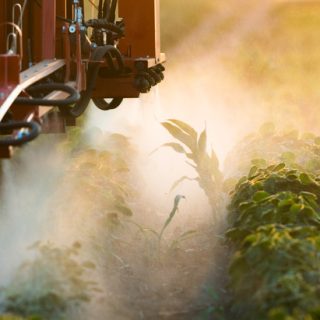
Two practical things follow. First, digital capabilities have the most value where the field is heterogeneous, because their characteristic output is differentiated action. On a field that is uniform end to end, a blanket approach is the right one, and digital adds little. Second, digital capabilities compound. A positioning system alone is a navigation aid. Combined with a section-controlled sprayer and a prescription map, it is a different operation altogether. Combined further with a decision model that learns from last season, it becomes something the earlier vocabulary does not quite describe.
Projects like Smart Droplets sit in the broader European effort to bring those compounded capabilities within reach of ordinary farms, not just research demonstrators.
“Digital” is not a louder tractor. It is a different kind of intelligence being added alongside the tractor, and the reason it matters is not that it is new, but because it changes what the tractor can be asked to do.